
What happens when development and economic recovery starts with community leadership? This exciting pilot project in southern Haiti was designed to be replicated. The report below shares the process, results, lessons learned, and recommendations from this effort. We encourage you to read the full report here, and share widely with others working to build sustainable, locally-driven solutions.
Executive Summary
In January 2025, the Quixote Center and Développement Communautaire Chrétien Haïtien (DCCH) launched a one-year pilot project designed to improve the living conditions of 100 families in the communities of Gouin and Sainte-Hélène while fostering a new generation of citizens who will shape their own economic future. We designed the initiative as a replicable model that can be expanded to other communities across Haiti. This report presents the project’s results, key lessons learned, and recommendations to strengthen future iterations.
- The project challenges cycles of dependency that have long characterized development efforts in Haiti. Often described as the “Aid State” or a “nation of NGOs,” Haiti has experienced decades of poorly structured assistance that has sustained the aid industry without building durable local capacity. This initiative sought to demonstrate a different approach—one rooted in community leadership, accountability, and self-reliance.
- Quixote Center selected DCCH as its local implementing partner based on its strong leadership, transparent communication, and extensive experience managing rural development programs in the Sud Department. As a member of Caritas, DCCH has established credibility and trusted relationships with local communities.
- The pilot project represented a total investment of approximately $75,000, disbursed in quarterly tranches, contingent upon the review of program reports and joint evaluation meetings. This structure ensured financial accountability and allowed for ongoing learning and adaptation during implementation.
- A strong evidence base guided the project design. In 2023, with support from Quixote Center, DCCH conducted a comprehensive needs assessment involving 134 community leaders, identifying key challenges, opportunities, and priorities for local socio-economic recovery. This participatory process helped ensure that the project responded directly to community realities.
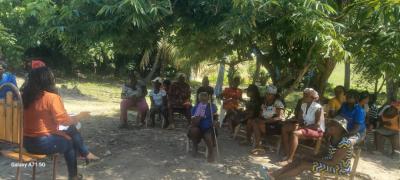
- Community ownership was central to the project’s approach. The first quarter focused on strengthening community cohesion and collective decision-making, an essential foundation for long-term sustainability. Participants played an active role in shaping the program, including selecting the types of seeds to cultivate and livestock to raise.
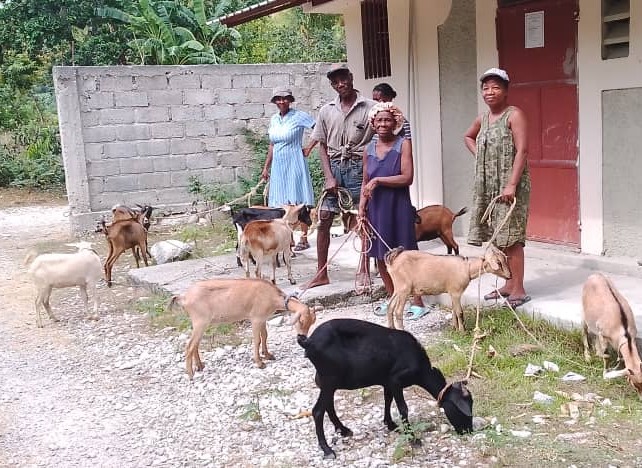
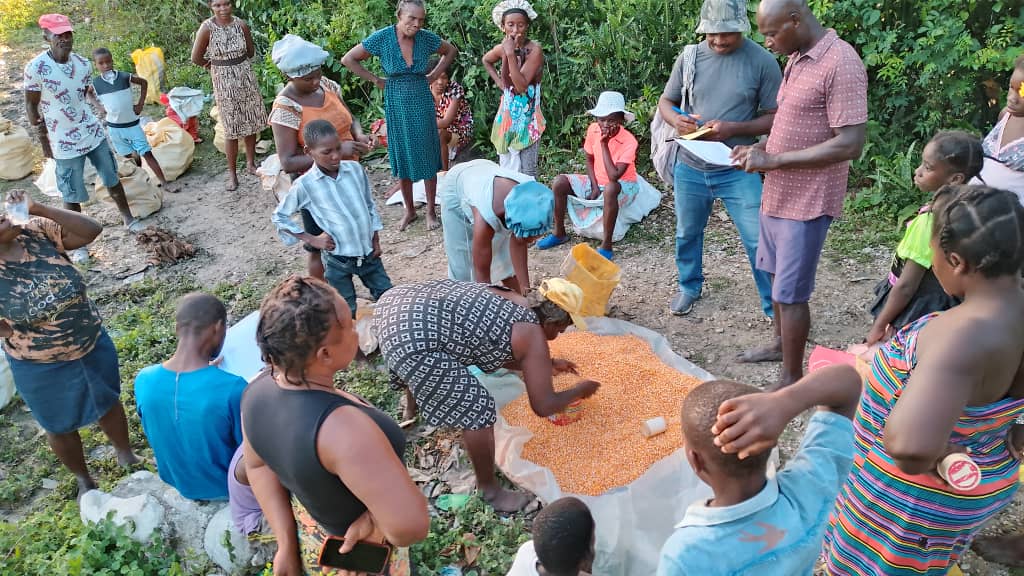
- Seeds and livestock were distributed through a community loan model designed to multiply impact over time. Beneficiary families agreed to return the same quantity of seeds after harvest and the first offspring of livestock to the program. These repayments allow additional families to benefit, creating a self-sustaining cycle of agricultural production and asset building.
- Following the selection of 100 participating households from Gouin, Sainte-Hélène, and Costa, DCCH collected baseline data to measure the program’s impact on agricultural productivity and household livelihoods.
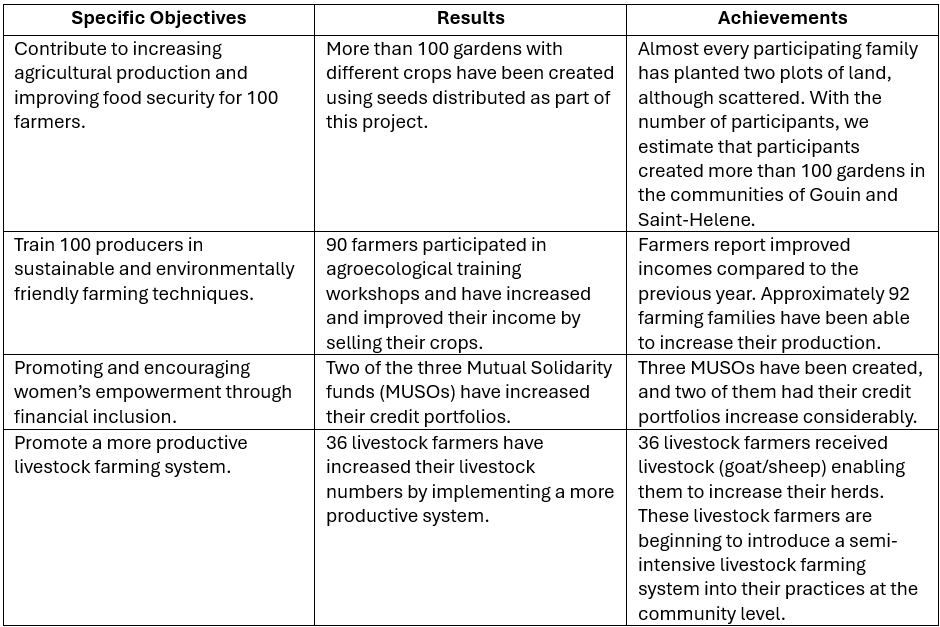
- Overall, the pilot project met or exceeded all objectives outlined in the project’s logical framework, demonstrating the effectiveness of a community-driven development model that prioritizes local leadership, shared responsibility, and sustainable economic growth.
Project impact in a nutshell: