




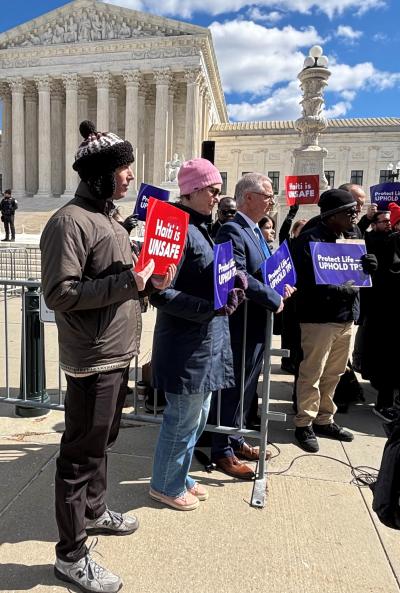
Temporary Protected Status (TPS) for Haitians is now before the Supreme Court, following a rapid series of legal developments over the past few weeks. Although the administration filed an emergency request on the Court’s shadow docket to lift protections immediately, the Court agreed to hear the case on its merits with full briefing and oral arguments in late April, with a decision likely in June. For the moment, TPS remains in place and deportations tied to ending TPS cannot move forward.
Congress created TPS in 1990, empowering the Department of Homeland Security to allow people from designated countries to live and work in the United States when conditions in their home countries make returning safely impossible due to natural disasters, armed conflict, or other “extraordinary and temporary” circumstances. It was never designed to permit people to stay in the United States permanently, and US administrations review it every two years to determine whether conditions merit keeping the status in place.
Current Conditions in Haiti
Haiti was first designated for TPS following the 2010 earthquake, because of widespread devastation and displacement. The designation has been extended several times due to years of compounding crises. The majority of TPS holders from Haiti arrived because they were displaced as a result of the earthquake. Many of them chose to resettle in the United States because they already had friends and family here.
After the assassination of Haiti’s last elected president in 2021, criminal gangs—armed by guns illegally trafficked from the US— have imposed a reign of terror in the capital and large parts of the Artibonite region in the north. Over a million people have been internally displaced, lacking reliable access to food, healthcare, and education.
These conditions are a key issue the Supreme Court will weigh.
What’s at Stake?
More than 350,000 Haitian nationals are currently protected under TPS. If TPS is terminated, they would all lose legal status and work authorization. The administration has made it clear that deportations would begin immediately and would target communities with large Haitian populations, such as Springfield, Ohio. Families with US-born children would face immediate instability and separation. These families live in near constant fear of deportation. Children often miss school due to barrages of racist insults, mistreatment, and fear of ICE detainment.
In Haiti, there is no system to receive people at this scale. No infrastructure for resettlement. Youth are in danger and most vulnerable to gang recruitment and violence. Adding hundreds of thousands of people to an already overwhelmed country would exacerbate the existing humanitarian crisis.
In the United States, Haitians represent a significant part of the workforce in key industries including healthcare, hospitality, agriculture, elder care, retail, and food service. Mass deportation would lead to critical labor shortages in already-understaffed industries. Center for Migration Studies found that 72% of Haitian TPS holders are employed, with 69% working in essential occupations. Altogether, TPS holders contribute an estimated $5.8 billion to the US economy, and approximately $1.5 billion in annual tax revenue.
But the consequences go far beyond the economy. The human cost is profound and immeasurable. Roughly 50,000 US-born children rely on TPS holder parents. Revoking these protections would cause significant hardship and instability for these families. Family separation at this scale would place added strain on the US foster care system, with an estimated 25,000 children in danger of entering it and leaving thousands of US-citizen children to navigate the loss of their parents’ care and protection.
Dr. Marie Bernadette Fouche, a physician on the Eastern Shore of Maryland, recently spoke at a press conference about the ongoing trauma these families, and especially the children are facing. Watch the video HERE.
Where Things Stand
-Earlier this year, the administration moved to terminate TPS for Haiti, arguing that conditions had improved significantly, despite the State Department’s 2025 travel advisory not to travel to Haiti due to kidnapping, crime, terrorist activity, civil unrest, and limited healthcare.
-A federal judge blocked the termination in February.
-On March 7th, a federal appeals court upheld the block, citing concerns that the administration failed to adequately assess the current conditions in Haiti and was motivated by blatant racism.
-The administration asked the Supreme Court to lift the lower court rulings immediately, which would allow TPS to end before the case is fully decided.
-Instead, the Supreme Court will grant full review of the case (Miot v. Trump), with arguments expected in late April.
-Several amicus briefs have been filed in support of the plaintiffs, including a coalition of 19 state attorneys general.
-Representative Ayanna Pressley introduced a discharge petition to force a House vote to extend TPS for Haiti. To date, 199 members have signed, 218 signatures are required. Follow the discharge petition HERE.
What happens next determines whether 350,000+ people can remain in the lives they have built here in the United States or if they will be forced to quickly leave them behind.
We will continue to update as the situation develops.
Comments
Tony Magliano (not verified)
Until the Trump cuts to foreign and domestic aid, which led to my position being eliminated, I was the outreach coordinator for Catholic Charities for the Archdiocese of Miami working in Key West and the Florida Keys. In that capacity I met many good, hardworking Haitians. Please let me know if there is any way I can help. Pace e bene, Tony
Quixote Center (not verified)
Thank you Tony. You can help by reaching out to your Member of Congress and Senators and let them know you support renewal of TPS for Haitians.
-Much peace back to you, Kim
Tom Vencuss (not verified)
This is an excellent summary of the current situation both in Haiti and here in the States. The ultimate hypocrisy of this administration, and supporters, is a willingness to return persons to a place which they deem as unsafe for their own people.
Carolyn (not verified)
I want Haitians to still have the TPS . What kind of people in the United States would want to send lovely women, children, & men back to their poor island country that have violent gangs roaming around terrorizing the communities?! This is still an unsafe time to go back to Haiti. Please don’t allow the TPS status to be dropped for Haiti. Speak up for these beautiful people who have gone thru SO MUCH.