




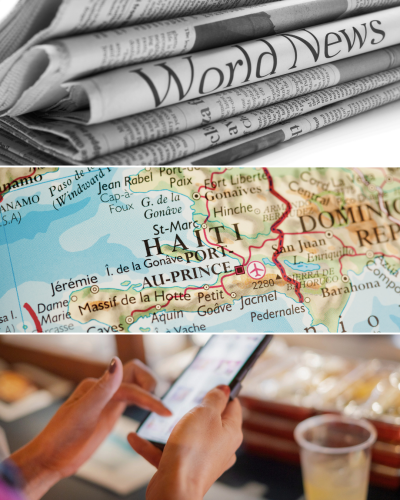
It starts with a notification. A headline flashes across the screen. It’s Haiti. Violence is escalating. A hurricane on the way. A migrant caravan. Another crisis breaking through.
A few days pass, and the alerts stop. The story slips out of view and disappears. What remains is an idea of crisis, without any context of what came before or what might come next.
It’s easy to assume that Haiti just gets crowded out of a 24-hour news cycle, but why Haiti? A country so close, you can be there in an hour and a half from Miami. A history so tied to us, it should be impossible to dissociate. And yet, we do.
Ask someone what they know about Haiti, and the answers are always fragments of something bad that happened. Maybe something about gangs, or migration, or the earthquake. The details are blurry.
And then there is how Haiti is portrayed when it does come into view. For decades, coverage has relied heavily on the same trope, “the poorest country in the Western Hemisphere,” and the predictable vocabulary that follows: Violent. Unstable. Corrupt. Impoverished. These terms reduce Haiti to a series of crises, stripped of context, history, and humanity.
Stories told this way create a narrative of Haiti as a place of constant disaster and instability. Without context, the news feels urgent at first, then familiar, then repetitive. Fatigue and resignation set in. A sense that nothing is changing, nothing ever will, and there is nothing we can do.
This isn’t an accident. The way we understand Haiti is shaped by our tangled history of racism, colonialism, and power.
The Haitian revolution created the first Black republic in the world, directly challenging the racial and economic order. In the US, where slavery was still firmly in place, this terrified US leaders, many of them slaveholders, who feared that this type of revolt might spread to their own plantations. What did it mean for a Black republic, born out of revolution, to exist so close to the United States?
Reflecting the fear and disdain for what Haiti represented, the US did not recognize Haitian independence until 1862, a full 58 years later. Haiti was positioned as a problem, not a peer. Soon after independence, Haiti was forced to pay massive reparations to France in exchange for recognition. That debt took generations to pay and depleted resources needed to build the country.
The US occupied Haiti from 1915-1934. What followed was a relationship marked by intervention, paternalism, and repeated external damage. Continuing the pattern, the US supported or tolerated repressive regimes that deepened instability, including the Duvaliers.
In the 1990s, US trade policies opened Haiti’s markets to subsidized American agricultural imports. Local rice production collapsed, farmers were displaced, and livelihoods destroyed. It accelerated migration to the cities and increased economic vulnerability throughout the country.
After the 2010 earthquake, a cholera outbreak that killed thousands was traced back to a contaminated waste site from UN Peacekeepers. Democratically-elected Jean-Bertrand Aristide was removed from power twice, in 1991 and 2004, in crises shaped, at least in-part, by international involvement.
Haiti was close enough so that successive US governments intervened, but never fully integrated into the average American consciousness. Americans don’t know the history of US interventions or policies, and so there can be no accountability. With this context missing, it seems that instability just happens, and Haiti is blamed again.
Racism moves through all of this quietly. It uplifts ideologies that are convenient and refuses to question the systems that put these conditions in place.
To really understand what’s happening in Haiti means sitting with some uncomfortable truths. Looking at the role of US policy, intervention, and our place in the story. It is not an easy story to tell, or to hear.
Without context, the stories are easier to move past. Haiti is reduced to what we’ve been taught to recognize. A series of urgent moments followed by silence, until the next alert.
Comments
Kimber Zappia (not verified)
Having been to Haiti many times in the past 15 years I am quite familiar with the narrative. I often must explain the story to Americans and why I visit. There are large parts of Haiti that, while feeling the impact of poor governance and natural disasters, are quiet, calm and oh so beautiful. The people are kind and simply want to raise their families. They long for a government that provides basic services and infrastructure. They want their children to receive a decent education so they can support their families. Most do not come to the USA because they want to leave Haiti. However, it is safer and they can provide for their children. We need a better policy regarding Haiti.
Joe Rudolph (not verified)
Very succinct and accurate description of the US involvement in Haiti and how the US augmented the injuries to the already fragile Haitian economy, politics and community life. Our country needs (on a national scale) to find ways to support the Haitian people and prevent further decline there. The first steps are to step back from our racist and elitist attitudes.